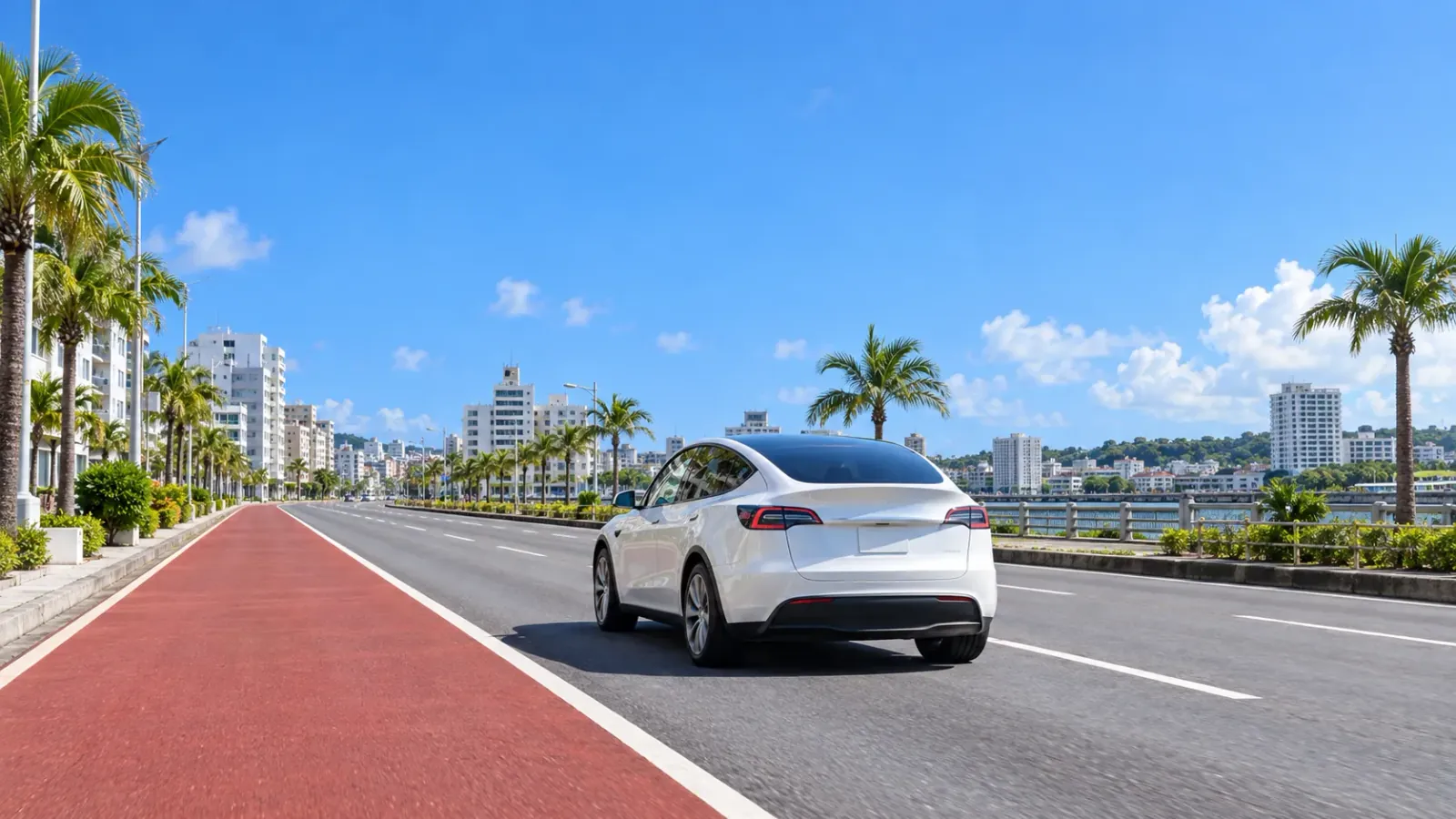
Okinawa is one of the nicest places in Japan for a road trip. The roads are wide, traffic is light and the coast keeps you company most of the way. For first-time drivers in Japan, the real risk usually isn't the driving itself. It's a rule you've never heard of. The 8 points below are the ones we get asked about most at handover, and the ones visitors most often trip up on.
The one that catches the most people
It isn't speeding. It's the bus-only lanes in central Naha during weekday rush hours. Foreign visitors get ticketed here more than anywhere else because the markings are in Japanese and the restriction only applies at certain times. See point 1.
1. Naha's bus-only lanes (the most common ticket)
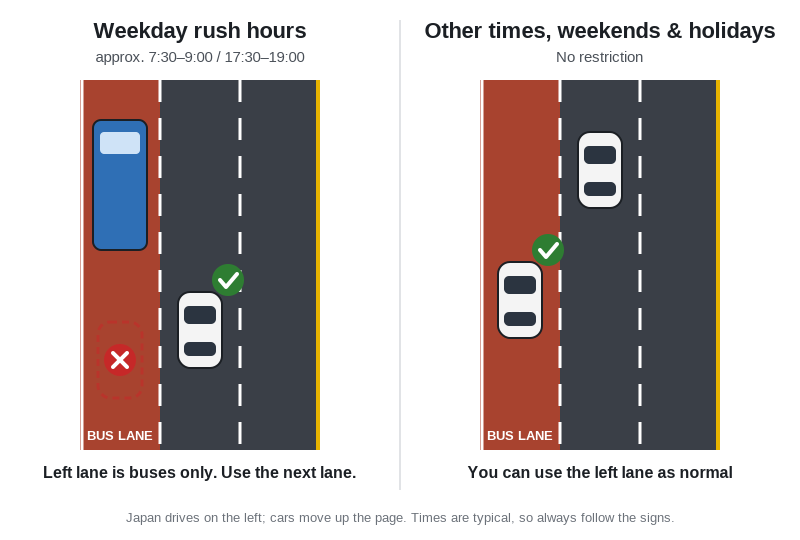
On Naha's main roads, one lane becomes bus-only during weekday commuting hours, and regular cars aren't allowed in it. Outside those hours you can drive in it normally. That's exactly why it's easy to get wrong: the same lane is off-limits in the morning and fine at lunchtime.
| Time | Weekdays | Weekends & holidays |
|---|---|---|
| Morning rush (approx. 7:30–9:00) | No regular cars | No restriction |
| Evening rush (approx. 17:30–19:00) | No regular cars | No restriction |
| Other times | Drive normally | Drive normally |
The lane is marked with text and colour on the road surface and with signs above junctions, all in Japanese. The practical approach is simple. If you're driving in central Naha on a weekday between about 7:30 and 9:00 or 17:30 and 19:00, stay out of the far-left lane and watch for a lane that only buses are using. If your plans already avoid commuting hours, as most visitors' do, you'll rarely run into it.
Restrictions can change
The roads and hours covered can change by official notice. If you'll be driving through Naha during weekday rush hours, go by the signs on the road and the latest announcements.
First time driving in Japan? We'll go over it with you
5 minutes from Naha Airport with a free shuttle. Our staff walk you through the car and the local rules at handover. Code RENSYS10 takes 10% off every model.
2. Drive on the left, steering wheel on the right
Japan drives on the left, with the driver's seat on the right. If you're from the UK, Australia or anywhere else that drives on the left, you'll feel at home. If you're used to driving on the right, two moments need extra care: the first 10 minutes behind the wheel, and right after a right turn, which is when people most often drift back into the right-hand lane without noticing.
- Do a lap of the parking lot before you set off to get a feel for the car's width and position on the road.
- After every right turn, tell yourself "keep left". It's the habit that helps most.
- Where the indicator and wiper stalks sit depends on the car. We'll show you at handover, so try them once before you pull out.
3. No turning on red, ever
In Japan you can't turn left or right on a red light. You have to stop and wait for green. There's no turn-on-red exception. If the signal shows a green arrow, follow the arrow.
4. 止まれ means a full stop
The red, upside-down triangle reading 止まれ (tomare) means stop completely. Slowing down isn't enough: the wheels need to stop turning, then check both ways before you go. Police do enforce this at these junctions, and rolling through counts as a violation. Rural Okinawa has a lot of small junctions with this sign, so the safest habit is simply to stop every time you see one.
5. Pedestrians always come first
If someone is on a pedestrian crossing, or about to step onto one, you must stop and let them cross. Japan enforces this far more strictly than many visitors expect, and it's a common target for police checks. Locals slow down as they approach any crossing, and it's a good habit to copy.
6. Zero tolerance on drink driving
Japan's drink-driving limits and penalties are much stricter than in most places, and the driver isn't the only one punished. Passengers, whoever served the alcohol and even the person who lent the car can be penalised too. "Just one drink" isn't an option. If you're planning to drink in the evening, leave the car at the hotel and take a taxi or the monorail.
7. Child seats are required by law
Children under 6 must ride in a child seat. It's a legal requirement, not a recommendation. If you're travelling with kids, add one when you book, as we can't guarantee stock on the day. Seatbelts are required in every seat, back seats included.
8. Parking and ETC
- Not every roadside spot inside white lines is a legal parking space, and Okinawa's towns do enforce parking rules. Use paid parking lots where you can.
- The main sights (Churaumi Aquarium, American Village, the outlet malls and so on) all have large car parks, most free or cheap.
- The Okinawa Expressway accepts ETC, and all our cars come with an ETC unit.
- Speed limits on the expressway differ from those on regular roads. Follow the posted signs.
What to do after an accident or breakdown
Having something go wrong abroad is everyone's worst case, so remember one thing: report every accident to the police, no matter how minor. Japanese law requires traffic accidents to be reported, and the rental insurance can only pay out with an accident certificate issued by the police.
- Get safe first. Turn on your hazard lights and, if the car can move, pull over somewhere safe.
- If anyone is hurt, call an ambulance on 119.
- Call the police on 110. Do this even for a light scrape, and even if the other driver says there's no need.
- Contact us and we'll tell you what to do next.
- Don't agree to settle privately or promise any payment at the scene. Leave that to the police and the insurance.
Insurance and what you'd pay
Basic insurance is included in the rental, with unlimited cover for bodily injury and property damage. If the car needs repairs after an accident, a non-operation charge (NOC) applies: ¥50,000 if you can drive the car back, ¥100,000 if you can't. The optional Premium Peace-of-Mind Pack (¥4,400 per day) waives both the deductible and the NOC.
For a breakdown, a flat tyre or a battery too low to drive, it's the same: stop somewhere safe first, then contact us. Please don't arrange a tow truck or repair shop yourself.
The rules are easy once you know them
Of the 8 points above, only two really need memorising before you go: keep out of the far-left lane in central Naha during weekday rush hours, and come to a full stop at every 止まれ sign. For the rest, stick to three principles: pedestrians first, no turning on red and no drinking. Driving in Okinawa will feel a lot easier than you might expect.
Traffic laws can change, so it's worth double-checking with official sources (Japan's National Police Agency, JAF or your rental company) before you travel. At handover we'll also run through the points that matter for your route that day.
FAQ
Is it safe to drive in Okinawa as a tourist?expand_more
Generally, yes. Roads are wide, traffic is light and local drivers tend to follow the rules. The main things to watch are driving on the left, Naha's bus lanes and slippery road surfaces when it rains. In wet weather, slow down and leave more space to the car ahead.
Do I need to call the police after a minor accident in Okinawa?expand_more
Yes. Japanese law requires every traffic accident to be reported to the police (110), and insurance claims need the accident certificate the police issue. Report it even for a light scrape and even if the other driver says not to bother, then contact the rental company.
What are the speed limits in Okinawa, and what happens if I speed?expand_more
The Okinawa Expressway limit is 80 km/h. On general roads the limit is 60 km/h where no sign is posted, and urban roads are often 40–50 km/h, so always follow the signs. Speeding brings a fine, and going 30 km/h or more over the limit on a general road, or 40 km/h or more over on the expressway, is treated as a criminal case, not just a ticket.
What's the most common traffic violation for tourists in Okinawa?expand_more
Driving in Naha's bus-only lanes during weekday rush hours. On weekdays from about 7:30 to 9:00 and 17:30 to 19:00, regular cars can't use those lanes, but they're open at other times and the signs are in Japanese, which is why so many visitors get caught. Avoiding central Naha at commuting times cuts the risk a lot.
Can you turn on a red light in Japan?expand_more
No. Both left and right turns on red are prohibited, and you must wait for green. If the junction has a green arrow signal, follow the arrow.
Do I really have to stop completely at a 止まれ sign?expand_more
Yes. Stop until the wheels are fully still, check both ways, then go. Just slowing down counts as a violation, and police in Japan do check for it.
Do I need a child seat for my kids?expand_more
Children under 6 are legally required to use a child seat. Add one when you book, as stock on the day isn't guaranteed.
Do I need to use the expressway in Okinawa?expand_more
Not necessarily. The Okinawa Expressway runs north–south through the main island and is handy when you're short on time, but the coastal Route 58 is far more scenic, and most visitors take regular roads when they have time. All our cars have ETC, so either option is easy.